


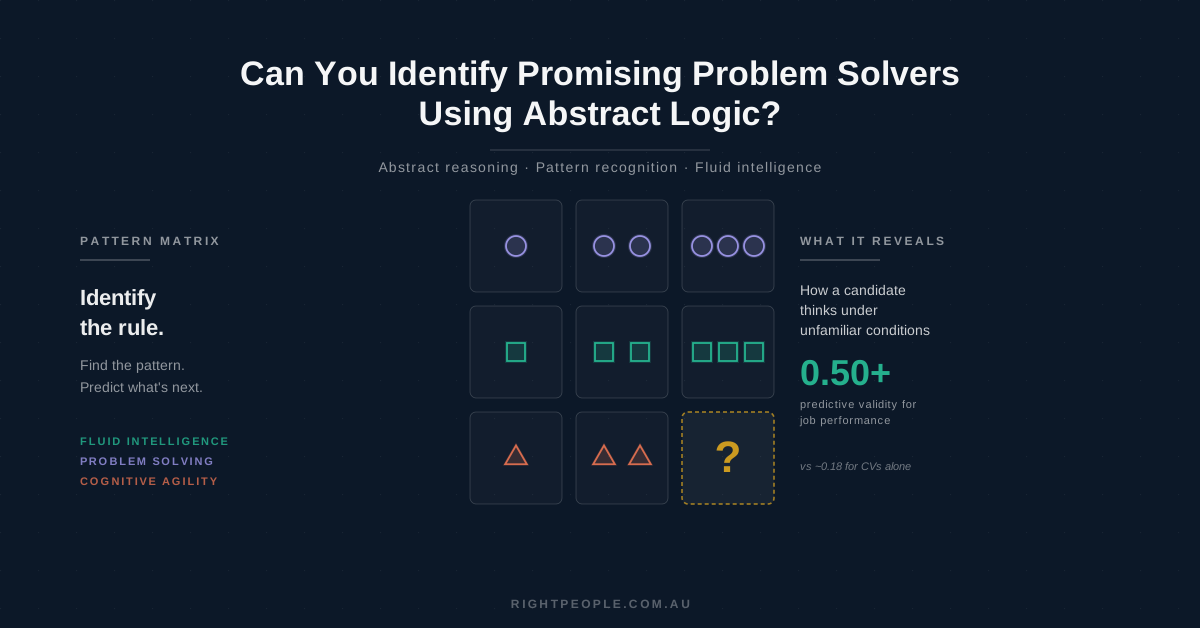
Yes — and the most reliable way to do so is with an abstract reasoning test. This type of assessment reveals how a person thinks when faced with an unfamiliar problem, independent of prior knowledge or formal training. It measures how quickly and clearly a candidate can identify patterns and reach sound decisions.
In our work with hiring teams across Australia, we have seen this pattern consistently: people with strong reasoning skills handle new challenges more effectively, learn faster, and adapt more readily to change.
What is abstract logic, and how does it measure thinking ability
Abstract logic refers to a non-verbal form of assessment that measures how effectively a person can identify patterns and solve unfamiliar problems without relying on prior knowledge or specific education.
Fluid intelligence vs learned knowledge
There are broadly two types of intelligence: learned knowledge and raw thinking ability. Learned knowledge is acquired through school, training, or work experience, while raw thinking ability is what helps a person solve genuinely new problems. Abstract logic tests measure this second type, revealing how a candidate handles situations they have never encountered before.
How pattern recognition works in real tasks
These tests ask candidates to identify patterns in shapes and sequences — without words or numbers, relying purely on logic. The cognitive demand is similar to that of real work: diagnosing a system error or interpreting a market shift both require pattern-based thinking. A pattern recognition test helps reveal how quickly and accurately someone connects ideas under such conditions.
How do abstract logic tests assess real problem-solving skills
Beyond simply showing whether a candidate can solve a particular puzzle, abstract logic tests reveal the underlying mental processes that drive real problem-solving — how a person identifies rules, holds information in mind, and works systematically towards an answer.
The rule induction process
In these assessments, candidates examine patterns and infer the underlying rules, then determine what should logically come next. No prior training is required — the test simply captures how the candidate thinks in the moment, which is close to how real workplace problems present themselves. This is also why many organisations use a non-verbal reasoning test: it removes language barriers and focuses purely on thinking ability.
Working memory and processing speed
Problem-solving is not only about logic — it also depends on how much information a person can hold and manipulate at once. Strong candidates can keep several ideas in mind simultaneously, compare options, and arrive at a clear answer. These behaviours reflect strong working memory and rapid processing speed, both of which underpin effective decision-making in demanding roles.
Why do CVs fail to identify true problem solvers
A polished CV can be deceptively reassuring. It documents what someone has done, but it tells you remarkably little about how they will perform when faced with an unfamiliar challenge — and that is precisely where strong problem solvers prove their worth.
The experience trap
A CV describes what a person has done before, but it does not reveal how that person will act in an unfamiliar situation. In our experience assisting Australian firms, a strong CV does not always equate to strong thinking ability — some candidates perform well only within familiar tasks and struggle when conditions change.
The need for cognitive agility
Modern roles require people who can think on the spot and adapt quickly. In our work with client organisations, candidates with strong reasoning skills tend to adjust to new roles roughly 40 per cent faster, because they are less reliant on past experience. A logical reasoning test helps reveal this capability, showing how a person responds when there is no obvious answer.
CV screening vs abstract logic testing
The differences between traditional CV-based screening and abstract logic testing become especially clear when set side by side:
| Feature | CV or Interview | Abstract Logic Testing |
|---|---|---|
| Measures | Past work | Thinking ability |
| Predictive power | Low (around 0.18) | Higher than 0.50 |
| Bias risk | High | Low |
| Training speed | Hard to judge | Easy to predict |
| Role fit | Fixed | Flexible |
This comparison highlights a clear gap. Traditional methods focus largely on a candidate’s history, whereas abstract logic testing focuses on their likely future performance.
Can abstract logic tests predict future performance
The short answer is yes — and the evidence supporting this claim is substantial. Two factors in particular explain why abstract reasoning translates so reliably into on-the-job results.
The general mental ability factor
Decades of research in workplace psychology consistently show that general mental ability is one of the strongest predictors of job success — and abstract reasoning plays a substantial role in measuring it. This effect holds across industries: whether in technology, finance, or operations, problem-solving remains a core skill that distinguishes high performers.
Identifying long-term potential
Sound hiring is not only about filling today’s role; it is about identifying people who can grow into broader responsibilities over time. Candidates with high reasoning ability typically learn faster and take on complex tasks with less support, which makes them especially valuable over the long term.
Are abstract logic tests fair for all candidates
Fairness in selection has never been more important, both ethically and commercially. Abstract logic tests are among the more equitable assessment tools available to employers today, for two related reasons.
The culture-fair advantage
Because these tests do not rely on language proficiency or specific cultural knowledge, they are inherently fair to candidates from different educational and linguistic backgrounds. A fluid intelligence test focuses solely on thinking ability, removing much of the bias linked to formal education or English-language familiarity.
Equal opportunity in hiring
This approach creates a level playing field: every candidate faces the same type of challenge, judged on the same dimensions. The result is a more equitable selection process that allows organisations to build diverse teams based on ability rather than background.
How do you ensure trust in cognitive assessments
Trust in any cognitive assessment ultimately rests on two things: how the results are scored against meaningful comparison groups, and how clearly those results are communicated back to the people making hiring decisions.
Standardised scoring and benchmarking
We compare each candidate’s results against relevant reference groups — for example, practising managers or experienced technical professionals. This gives hiring managers a meaningful benchmark: the score is not abstract or arbitrary, but anchored in real performance data.
Clear and useful reports
- Shows how a person thinks
- Highlights cognitive strengths and gaps
- Helps managers make quick, informed decisions
- Supports better onboarding and development planning
Our reports prioritise clarity, explaining each candidate’s thinking style rather than presenting raw scores in isolation.
How we use abstract logic testing to improve hiring decisions
At RightPeople, cognitive testing forms part of a structured, evidence-based hiring process. We match tests carefully to the requirements of each role, focusing on the demands of the actual work rather than relying solely on CVs. This approach helps us uncover hidden talent — candidates whose backgrounds may not stand out on paper, but whose thinking ability marks them as strong potential hires.
We see particularly strong results in graduate recruitment, where early-career candidates with high reasoning scores tend to develop faster and progress further. This connects closely with the approach we explore in Why is Cognitive Testing the Ultimate Predictor of Success?, where we examine how thinking ability shapes long-term performance.
Conclusion
Abstract logic provides a clear view of how a person thinks — how they handle unfamiliar problems and adapt to change. In our experience, it remains one of the most reliable ways to identify strong problem solvers, reducing bias and sharpening hiring decisions. Organisations that prioritise thinking ability when selecting talent tend to build stronger, more flexible teams that are well-equipped for whatever comes next.
FAQs
To round out this overview, here are answers to the questions we are most frequently asked about abstract reasoning testing.
How do I pass an abstract reasoning test?
To perform well in an abstract reasoning test, focus on identifying patterns quickly and accurately. Practise different types of sequences — shapes, rotations, and progressions — and learn to manage your time so you do not get stuck on any single question. With regular practice, pattern recognition becomes both faster and more reliable.
Is 80 per cent a good score in an aptitude test?
Yes — 80 per cent is generally considered a strong score and usually places a candidate above average. That said, what counts as a good score depends on the specific role, the norm group used, and the level of competition for the position.
Is abstract reasoning linked to high IQ?
Abstract reasoning is closely linked to IQ, as it reflects how well a person can think logically and solve new problems. High scores typically indicate strong cognitive ability, although a full IQ assessment draws on a wider range of tests covering verbal, numerical, and spatial reasoning.
Why do employers use abstract reasoning tests?
Employers use these assessments to understand how candidates think in unfamiliar situations. They measure problem-solving ability, learning speed, and adaptability — all of which make them useful predictors of on-the-job performance.
Can you improve your abstract reasoning skills?
Yes — these skills can be improved with regular practice. Working through puzzles, pattern-based questions, and timed exercises helps build both speed and accuracy. Over time, the brain becomes more efficient at recognising recurring patterns and applying the right logic.
What is a good abstract reasoning score?
A good score depends on both the test used and the role being assessed. In most cases, scoring above the average percentile is considered good, and higher scores indicate stronger problem-solving ability and faster thinking under pressure.


