


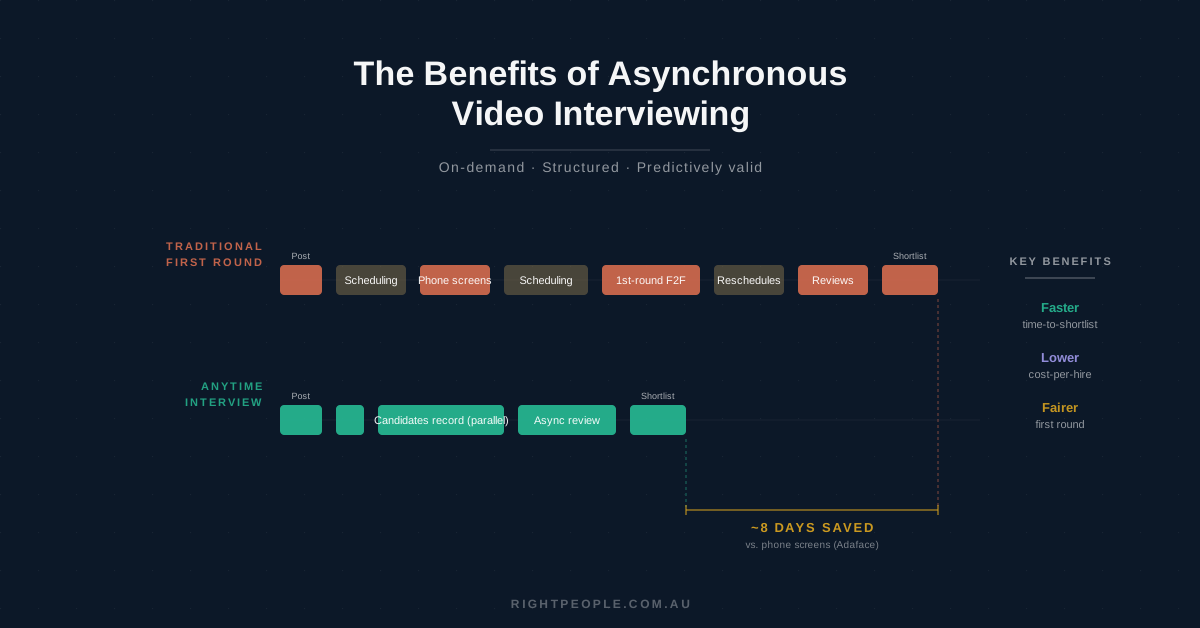
First-round interviews used to swallow days of recruiter time before anyone had even been shortlisted. Diary back-and-forth, phone tag, time-zone juggling, no-shows, reschedules — all to confirm what could often be assessed in a fifteen-minute structured screen.
Asynchronous video interviewing changes that economics entirely. Candidates record short, structured answers on their own schedule. Hiring teams review on theirs. The whole first round happens in parallel, around everyone’s calendar, with no scheduling overhead — and the data hiring managers walk away with is more consistent than any rushed phone screen could ever produce.
What is asynchronous video interviewing
Asynchronous video interviewing — sometimes called one-way, on-demand, or recorded video interviewing — is a structured first-round screen in which candidates respond to a fixed set of pre-recorded questions on camera, in their own time. The hiring team reviews the recordings later, scoring each candidate against the same criteria.
How it differs from a Zoom or Teams interview
A live video interview is essentially a phone screen with a camera attached: it still requires diaries to align, both parties present at the same time, and the interviewer’s energy and consistency to hold steady across every conversation. Asynchronous interviewing removes the scheduling problem altogether and replaces ad-hoc questioning with a standardised question set — every candidate answers the same prompts in the same order, under the same conditions.
How it actually works in practice
The recruiter or hiring manager defines a small set of competency-based questions for the role. Candidates receive a single link, click “start interview”, and record their answers — typically with a brief preparation time per question and a set response window. The platform stores the recordings and presents them in a dashboard where reviewers can watch, score, and share — often at faster playback speeds — without ever having to coordinate a calendar.
Why hiring teams are switching to asynchronous interviewing
The shift towards asynchronous video isn’t driven by novelty — it’s driven by hard, measurable improvements across the three things hiring teams care about most: time, cost, and decision quality.
Reclaim hours of scheduling time every week
The single biggest cost of traditional first-round interviewing isn’t the interview itself — it’s the scheduling overhead around it. For a role attracting twenty viable candidates, that means twenty diary negotiations, twenty calendar holds, and inevitably several reschedules and no-shows. Asynchronous interviewing collapses that entire layer of work to a single bulk invitation. Candidates respond when it suits them; recruiters review when it suits them.
Reduce cost-per-hire
Early-stage face-to-face interviews are an expensive way to discover that a candidate isn’t a fit. Travel time, room bookings, multiple interviewers blocking out two hours each — and a significant share of that investment is spent on people who never reach the final round. By moving the initial screen to a structured asynchronous format, hiring teams reserve their in-person time for genuine finalists, and the cost-per-hire drops meaningfully.
Cut time-to-shortlist
Industry research suggests asynchronous video can reduce hiring timelines by roughly eight days compared to phone screens alone. Recruiters can review recordings at 1.5× speed, skip forward to the answers that matter most, and shortlist far more candidates in the same window — a meaningful advantage in any tight talent market.
Create a fairer, more consistent first round
Live interviews are notoriously inconsistent. Tired interviewers ask different questions, follow up on different threads, and apply different mental yardsticks across the morning. Asynchronous interviewing standardises the experience: every candidate gets the same questions, the same prompts, and the same response time. Combined with structured scoring matrices, that consistency is one of the most reliable ways to reduce unconscious bias in early-stage screening.
Improve the candidate experience
Done well, asynchronous interviewing is also better for candidates. They don’t lose half a day to a thirty-minute screen, they can record at a time that genuinely suits them — including outside business hours — and they avoid the awkwardness of stilted phone interviews. For passive candidates in particular, the lower scheduling barrier is often the difference between engaging and dropping out of the process altogether.
Does the science actually support it
Asynchronous video interviewing is sometimes dismissed as a convenience tool — a faster way to do what hiring teams were already doing. The research suggests the opposite: when it is structured properly, it is a measurable upgrade in predictive validity over the unstructured first-round conversations it replaces.
Structured interviewing is the most predictive interview format
Decades of organisational psychology research consistently show that structured interviews — where every candidate is asked the same set of behavioural or competency-based questions and scored against the same criteria — predict on-the-job performance significantly better than unstructured ones. Asynchronous video forces this structure by design. Every candidate sees the same prompts, in the same order, with the same response time.
Standardisation reduces unconscious bias
One of the strongest arguments for asynchronous interviewing is that it removes many of the small, unintentional cues that shape live first impressions — the rapport-building chat, the shared alma mater, the interviewer’s mood that day. Candidates are evaluated on their answers to defined questions, scored by defined criteria, and reviewed by multiple stakeholders if needed. The data hiring teams act on is genuinely comparable across candidates.
How RightPeople’s Anytime Interview works
At RightPeople, we built our own asynchronous video platform — Anytime Interview — specifically because the generic video tools on the market weren’t designed with hiring science in mind. Most are essentially recording apps with a dashboard bolted on. Ours is built around three principles drawn directly from organisational psychology.
Competency-based questions designed by organisational psychologists
Every question in an Anytime Interview is competency-based and tailored to the specific role, with a defined scoring rationale built in. That means hiring teams are no longer relying on gut feel — they are evaluating candidates against the same measurable criteria that decades of selection research have shown to predict on-the-job performance.
Structured scoring and side-by-side review
Reviewers score each response using structured rating matrices with suggested answer criteria, then compare candidates side-by-side on the dashboard. Multiple reviewers can contribute scores independently, which significantly reduces the impact of any single interviewer’s biases on the final shortlist — without adding a single minute of meeting time to anyone’s calendar.
Built for in-house teams and recruitment agencies
The platform supports both directions of the hiring market. In-house HR teams use it to manage high-volume intake more efficiently and identify unsuitable candidates before investing in face-to-face interviews. Recruitment agencies use it to pre-screen candidates ahead of phone interviews and to share candidate recordings directly with their clients for faster approval — turning what used to be days of back-and-forth into hours.
A candidate experience that reflects your brand
Invitation emails carry your company logo and your messaging. Candidates receive a single direct link — no account creation, no extra apps — and complete the interview on any device. The experience is consistent, professional, and unmistakably yours, which matters as much to employer brand as it does to operational efficiency.
Common concerns about asynchronous video interviewing
Whenever a new format reshapes a familiar process, hiring teams reasonably ask whether it really is an upgrade. The most common concerns we hear fall into three categories — and all three have clear, evidence-based answers.
Will candidates actually accept it?
This was a fair concern five years ago — it isn’t really one any more. Asynchronous video is now a mainstream part of how Australian and global organisations recruit, and candidates increasingly expect the flexibility it offers. Where candidate friction does appear, it almost always traces back to a poorly designed experience — too many questions, vague instructions, or a clunky platform. A well-designed async interview typically takes a candidate fifteen minutes and feels respectful of their time.
Does it work for senior or technical roles?
Yes — though the role of asynchronous interviewing changes as seniority rises. For high-volume entry-level roles, async interviewing often handles the entire first round. For senior, technical, or executive positions, it works best as a single structured screen that surfaces communication style, competency depth, and motivation before progressing to deeper face-to-face or panel conversations. Either way, it sharpens the inputs that go into the rest of the process.
Does it replace face-to-face interviewing entirely?
No, and it shouldn’t be expected to. Asynchronous video interviewing is a first-round tool. Its purpose is to make the rest of the hiring process more efficient and more evidence-based — not to remove human judgement from the final decision. The best hiring processes use it to ensure that face-to-face time is spent only on genuine finalists.
How to get the most out of asynchronous video interviewing
The technology itself does not guarantee a better hire — the design of the interview does. A handful of practical principles consistently separate effective async interviews from frustrating ones for both sides.
Keep the interview short
Three to five well-chosen questions is almost always enough at first-round stage. Longer interviews increase candidate drop-off without materially improving decision quality. Save deeper exploration for the structured face-to-face stage.
Be transparent with candidates
Tell candidates how long the interview will take, who will be reviewing their responses, and when they can expect to hear back. Transparency about the process is one of the strongest predictors of candidate satisfaction — regardless of the eventual outcome.
Use structured scoring from day one
The single biggest mistake we see is hiring teams adopting async video tools but continuing to score them with gut feel. The format only delivers its full predictive validity advantage when responses are evaluated against defined criteria. Platforms like Anytime Interview build this discipline in by default, with rating matrices and suggested answer criteria for every question.
Conclusion
Asynchronous video interviewing isn’t a passing trend — it is a structural shift in how the first round of hiring is conducted, driven by genuine improvements in time, cost, and decision quality. Hiring teams that adopt it well reclaim hours of scheduling time every week, cut their cost-per-hire on roles that don’t progress, and put a more consistent, more evidence-based first round in front of every candidate they assess.
For Australian organisations weighing up where to start, our Anytime Interview platform was designed from the ground up around the principles of structured interviewing and predictive validity — built for HR teams and recruitment agencies that want the efficiency of async video without giving up the rigour of evidence-based selection.
FAQs
Below are the questions we are most frequently asked when hiring teams are evaluating asynchronous video interviewing for the first time.
Is asynchronous video interviewing the same as a one-way interview?
Yes — “asynchronous video interview”, “one-way video interview”, and “on-demand video interview” all refer to the same format: candidates record responses to a fixed set of questions in their own time, and the hiring team reviews them later.
How long should an asynchronous video interview be?
Most effective first-round async interviews include three to five questions and take a candidate around ten to fifteen minutes to complete. Longer interviews tend to increase drop-off without improving decision quality.
Can candidates re-record their answers?
This depends on the platform’s configuration. Some platforms allow one or two retakes per question, while others record only the first attempt to simulate live conditions. Both approaches have merit — the right choice depends on what the role itself actually requires.
Is asynchronous video interviewing fair to all candidates?
When it is designed properly — structured questions, standardised conditions, structured scoring, and clear instructions for candidates — it is generally fairer than the unstructured live interviews it replaces. Every candidate faces the same questions, in the same order, with the same time to respond.
Does asynchronous video interviewing work for executive and technical roles?
Yes — though typically as one component of a broader process rather than the whole first round. For senior roles, it surfaces communication style, competency depth, and motivation before deeper face-to-face conversations.
How do candidates feel about being recorded?
Most candidates report a positive experience when the interview


