


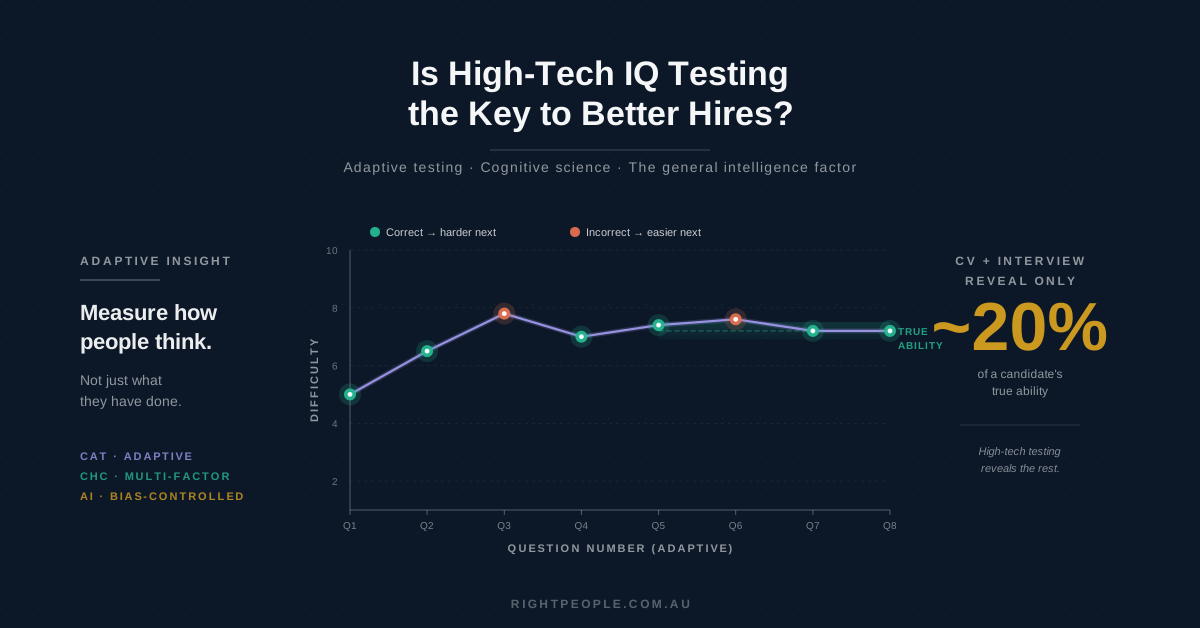
Yes — high-tech IQ testing helps employers make better hiring decisions because it reveals how people think and learn, rather than simply documenting what they have done before. It produces clear, measurable data that interviews alone routinely miss.
When we assess the general intelligence factor, we are no longer guessing. We are measuring how a person is likely to perform once they actually step into the role.
Why do traditional hiring methods miss top talent
Traditional hiring methods miss top talent because they focus heavily on past experience and communication style rather than on real thinking ability — and those two things often diverge.
Are CVs and interviews enough to assess real capability?
We have seen this play out many times: a candidate looks perfect on paper, performs well in the interview, and then struggles once the job actually starts. The reason is that interviews tend to test preparation rather than genuine thinking, and a CV documents past work without revealing how someone adapts to unfamiliar challenges. As a result, even strong candidates can be misjudged on both sides — written off when they have real potential, or hired despite poor fit.
What is the real risk of relying on intuition?
When hiring decisions lean too heavily on gut feeling, results become inconsistent — some hires succeed, others quietly don’t. From our experience working with large Australian organisations, this typically leads to slower onboarding, poor role fit, and higher replacement costs. The issue is not effort or care, but missing data. That is precisely where structured cognitive testing begins to make a measurable difference.
What makes high-tech IQ testing different today
High-tech IQ testing differs from earlier generations of cognitive assessment in two important ways: it adapts to each candidate in real time, and it measures genuine ability rather than fixed test performance.
How is modern testing different from traditional IQ tests?
Older IQ tests were fixed — every candidate answered the same questions in the same order regardless of their ability, which often produced inaccurate results at both ends of the scale. Modern assessment is adaptive: the test responds to how a person answers, tailoring the difficulty as it goes.
What is Computerised Adaptive Testing (CAT)?
Computerised Adaptive Testing works progressively. If a candidate answers correctly, the next question becomes harder; if they struggle, the difficulty steps down. This delivers a much clearer picture of true ability in significantly less time. It also gives us a more reliable read on the g factor in intelligence — the underlying capacity that explains how well someone can solve a wide range of different problems.
Why does this matter in hiring?
It matters because today’s roles are anything but static. People need to learn quickly and handle situations they have never seen before. Adaptive testing measures that capacity directly, rather than inferring it from past job titles or qualifications.
How does cognitive science improve hiring accuracy
Cognitive science improves hiring accuracy by breaking intelligence into measurable components and linking each one to the specific demands of the role being filled.
What is the CHC Theory, and why does it matter?
We rely on proven science rather than convenient assumptions. One of the foundational models we use is the Cattell-Horn-Carroll (CHC) theory of cognitive abilities, which separates intelligence into distinct components — some people are particularly strong at solving novel problems (fluid reasoning), while others draw heavily on accumulated knowledge (crystallised intelligence).
How do we apply this in real hiring scenarios?
We match these specific abilities to the demands of each role. A rapidly evolving role typically requires strong fluid reasoning, while a deeply technical role may depend more on retained domain knowledge. The result is a full view of a candidate’s cognitive ability factor, rather than the surface impression conveyed by a CV.
What insight does this give employers?
It helps answer one of the most important questions in hiring: can this person grow into the role, not just start it? That shift in focus — from past performance to future capability — meaningfully changes outcomes.
Can high-tech IQ testing actually predict job performance
Yes — and the mechanism is straightforward. By measuring how quickly a candidate learns and how effectively they solve unfamiliar problems, modern testing forecasts real on-the-job performance more reliably than almost any other single hiring tool.
How much of a candidate’s potential is usually hidden?
In our experience, CVs and interviews together reveal only around 20 per cent of a candidate’s true ability. The remaining 80 per cent — how they actually think, learn, and adapt under pressure — sits beneath the surface and is invisible to traditional assessment methods.
What does predictive insight look like in practice?
Modern assessment lets us see how quickly a candidate picks up new systems, how they react when conditions change, and how they solve problems they have never encountered before. These are precisely the behaviours that determine performance in the first year of any role.
Why does this reduce hiring risk?
When general mental ability (GMA) is incorporated into hiring, outcomes become noticeably more consistent. People reach productivity faster and handle unfamiliar challenges with greater confidence. This does not eliminate hiring risk entirely, but it reduces it in a clear, measurable way. The purpose of high-tech IQ testing is not to filter people out — it is to reduce uncertainty in decisions that have long-term consequences.
Does high-tech testing reduce bias in hiring
Yes — it reduces bias by focusing purely on performance and removing the personal and background-based cues that quietly influence interviewers, often without their awareness.
How does bias affect traditional hiring?
Bias is usually unintentional. It can creep in through how someone speaks, where they studied, whether they share interests with the interviewer, or how closely they resemble the person making the decision. These small signals can disproportionately influence consequential choices.
How do AI-driven assessments improve fairness?
High-tech testing strips away those signals and concentrates only on actual performance. Our process relies on:
- Standardised testing conditions for every candidate
- No personal or demographic inputs in the scoring
- Clear scoring based purely on answers, not impressions
The result is a markedly fairer comparison across all applicants — one based on capability rather than presentation.
What is the real benefit for businesses?
We have consistently seen that teams become stronger when selection is grounded in ability rather than impression. Using structured data such as the intelligence quotient factor helps identify talent that conventional methods regularly miss — including candidates whose backgrounds do not fit the usual pattern.
How do traditional IQ tests compare to high-tech assessments
The contrast between traditional and modern cognitive testing is sharpest when laid out side by side:
| Feature | Traditional IQ Tests | High-Tech Testing (Our Approach) |
|---|---|---|
| Test format | Fixed questions | Adaptive questions |
| Duration | 60+ minutes | 15–20 minutes |
| Accuracy | General score | Role-specific insights |
| Bias control | Limited | AI-based fairness checks |
| Security | Easy to share answers | Large question banks |
| Reporting | Static score | Clear, detailed reports |
This comparison highlights a clear shift in approach. Testing is no longer simply about producing a score — it is about generating real understanding of how a candidate is likely to perform.
Is there scientific proof behind cognitive testing
Yes — decades of peer-reviewed research consistently identify cognitive ability as one of the strongest predictors of job success across virtually every industry and role type.
What makes cognitive ability the strongest predictor?
Research has shown repeatedly that thinking ability is tightly linked to job performance. People who learn faster tend to perform better over time, and the effect compounds as roles become more complex or change more rapidly.
How do we ensure testing is credible?
We follow recognised international standards, including the International Test Commission (ITC) and Australian Psychological Society (APS) guidelines, which ensures our methods are scientifically valid, ethically administered, and fair to all candidates.
What does this mean for employers?
It means hiring decisions can be grounded in evidence rather than impression. We focus on human intelligence measurement that reflects real workplace demands, not abstract test-taking ability.
Can you trust AI-driven hiring tools
Yes — provided they are built properly, with transparent logic, explainable outputs, and clear human oversight at every stage.
Are these systems “black boxes”?
They do not have to be. We deliberately design our results to be clear, explainable, and easy for hiring managers to interpret without specialist training.
What does transparent reporting look like?
Rather than handing over a single number, we explain what each score actually means in the context of the role. Hiring managers can see exactly why a candidate fits or doesn’t fit — and what the result implies for onboarding and development.
Why does local data matter?
We have built our approach on years of data from the APAC region, which keeps our norm groups relevant and our results meaningful for Australian and New Zealand hiring contexts — not pegged to overseas benchmarks that may not apply locally.
Is high-tech IQ testing the future of hiring
Yes — but only when it is used as part of a broader, structured hiring process rather than as a standalone filter.
Should companies replace traditional hiring methods?
No. Testing works best when it is layered alongside structured interviews and other evidence-based methods, not used in place of them.
What is the smarter approach?
The strongest hiring decisions come from combining multiple complementary methods into a single, coherent process. For a deeper exploration of how this works in practice, our companion article Why is Cognitive Testing the Ultimate Predictor of Success? walks through the underlying research and shows how cognitive assessment integrates with the rest of the hiring workflow.
Conclusion
High-tech IQ testing helps us understand something simple but consequential: how a person actually thinks. That single insight reshapes hiring decisions — reducing guesswork, sharpening predictions, and giving hiring teams real confidence in the people they bring on board.
In our experience, better hiring rarely comes from asking better interview questions. It comes from measuring the right things, with the right tools, at the right point in the process.


